
8414 Sabal Industrial Blvd, Tampa, FL 33619
Hurricane Strong. STH Strong
Mon – Fri 8:00AM – 5:00OM / Sat-Sun – Closed
Updated October 1, 2026 · Buyer’s Guide
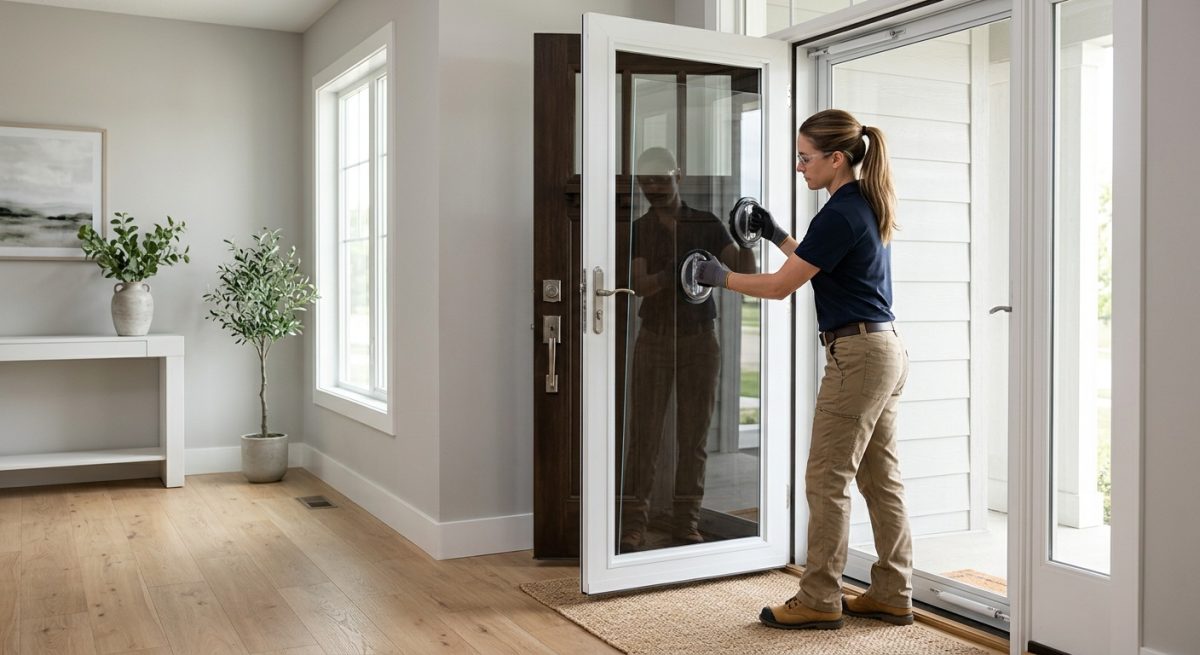
If you are searching for Larson storm door glass, something on your door has probably gone wrong: a crack, a foggy haze, a rattle, or a pane that just looks different than it did. The most useful first step is not ordering glass. It is working out what kind of failure you have, because a cracked pane, a failed seal and a worn-out door call for three different responses.
This page is not published by Larson, and STH Windows & Doors does not list Larson’s parts, glass sizes or specifications. Storm doors are not among the products we list on our site, so you will not find a replacement pane here. What you will find is a way to read the damage, a plain guide to the glass types you may run into, a way to choose between repair, replacement and upgrade for a Tampa entry, and the entry doors we do carry in Tampa, St. Petersburg and the surrounding area.
Start with a good look in daylight, from inside and outside, and take photos. Each symptom below points somewhere different.
Cracks that begin at the perimeter are often tied to stress rather than a hit: a frame that has flexed or racked, a pane pinched too tightly by its retainer, or repeated heating and cooling in direct Tampa sun. Replacing the pane without finding the cause can mean the new one cracks the same way, so check how the door sits and swings before you order anything.
A web or star pattern around a single point usually means something struck the glass. That is the simplest case. It is one-off damage, and if the rest of the door is sound, a matching pane is a reasonable fix. Treat it as a safety issue until it is dealt with, because cracked glass can release pieces.
If a panel has two layers of glass sealed together and moisture shows up between them, the seal around the edge has failed. You cannot wipe it away from either side. The glass unit usually has to be replaced, since there is no practical way to restore a broken seal at home. This only applies to double-layer glass, because a single pane cannot fog between layers.
Water beads on the inside or outside face of the pane are a humidity issue, not a failed seal. Tampa’s humid air can condense on cool glass in the morning or after the AC has been running, and it wipes away. If it returns every day and also shows up around the frame, the cause may be air leaking around the door rather than the glass.
Not every storm door panel is glass. Some are plastic, and plastic can scratch, cloud or warp with sun exposure over time. A cloudy plastic panel is rarely a safety problem, but it will not clean up, so replacing it is more a cosmetic decision than an urgent one.
A pane that moves or rattles usually points to a worn gasket, a loose retainer or a bead that has slipped, not to the glass itself. Look at the seal and retainer before you buy anything. Left alone, a loose pane lets in water and puts uneven stress on its edges, which brings you back to the first symptom.
Knowing the type helps you ask for the right replacement and explains why some failures look the way they do.
Whichever type your door uses, a replacement should be a safety type matched in size and thickness. Handle cracked panes with gloves and eye protection, tape them before you move them, and keep children and pets away until the job is done.
This table lines up what you notice with what it usually means and where it usually leads. Use it as a starting point, not a verdict.
| What you see | What it usually means | Usual next step |
|---|---|---|
| One impact crack, door otherwise tight | One-off damage to the pane | Replace the pane with matching safety glass |
| Crack at an edge or corner | Stress from frame movement or a tight retainer | Check the door’s fit and retainer, then replace the glass |
| Fog between two layers | Failed edge seal in an insulated unit | Replace the glass unit |
| Water beads that wipe away | Surface condensation from humidity | Clean it, then look for air leaks around the door |
| Rattling or loose pane | Worn gasket, loose bead or retainer | Replace the seal or retainer before the glass |
| Cloudy or scratched plastic panel | Surface wear from sun and cleaning | Replace for looks when it suits you |
| Glass trouble plus a sagging, sticking or corroded door | A door near the end of its life, not just a bad pane | Consider a new door or an upgraded entry |
To compare two quotes on equal terms, make sure each one names the glass type, the exact size and thickness, whether seals and retainers are replaced, and what happens to the old pieces. If you are comparing Larson with other brands, or a glass fix with a new door, hold every option to the same size, glass type and scope.
We do not list storm doors, storm door glass or replacement panels on our site. We do sell and install entry doors and glass-forward doors, and these are the lines you can browse today.
The doors overview is a good place to start if you are weighing the whole entry.
For a single clean break in a sound door, replacing the glass is the sensible choice, though it is not something we offer on this site. If you are on a second or third repair, or the glass is only one of several problems, the money is better spent on the entry itself. In Florida’s wind-borne debris region, glazed exterior openings need impact-rated glass or approved shutters, and your permit office makes the final call for your address. Do not count on a storm door to meet that requirement. Look for a Florida Product Approval or Miami-Dade approval number on the product.
When you are ready to look at the entry, call or request a free estimate. Tell us what your door is doing and what you want it to do, and we will talk it through with our no-pressure approach. Our financing options are worth a look as well.
Tell us what your door is doing and what you want it to do, and we will talk through the entry doors we carry. Call (813) 775-4113 or request your free estimate.